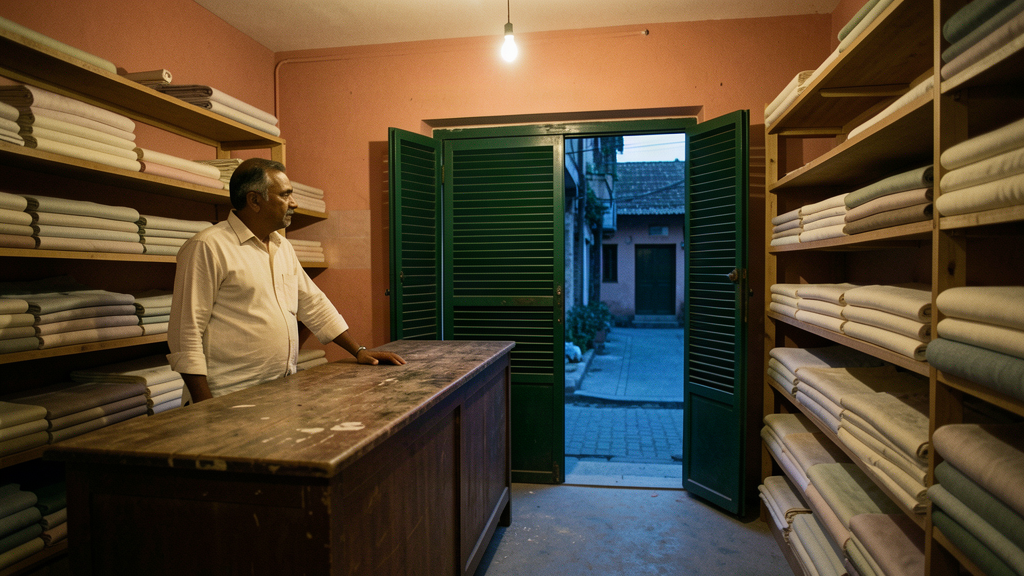
December is the one month when the counter slows down but the owner's mind speeds up. Between the year-end sale, new stock and next season's orders, there is one hour that pays for itself many times over: an honest look back at the year that is ending.
Most small shops do not need a fifty-page business plan. They need one page of truth. What actually earned money this year. What quietly wasted it. What deserves a repeat in January and what deserves to be dropped.
This is not accounts work and it is not a tax exercise. It is a review, done with twelve questions, each answered in one sentence, using records a shop already keeps. Set aside one hour. Put the phone on silent. Take a pen and a single sheet of paper.
Before You Sit Down: Gather Four Things
Fifteen minutes of gathering saves an hour of guessing. Keep only four items on the table.
- Your monthly sales total for the year. This can come from your order register, your billing book, or the monthly summary in your UPI and card settlement statement. You do not need every bill, only one total per month.
- Your best-selling products or services. A rough list from the register is enough. If you have never ranked them, start with the items you reorder most often and the jobs you are called for most.
- Your Google Business Profile performance page. Sign in to your profile, open Performance, and choose a date range that covers the year. Google lists searches, views, direction requests, calls, website clicks and messages for verified profiles, and the search-terms list refreshes at the start of each month. Write down the yearly totals for calls, directions and website clicks.
- Every recurring charge. Open one bank or card statement and list each monthly deduction: software, ads, delivery apps, storage, that tool you signed up for in March and never opened again.
Three Questions About Money
1. What was my total sale for the year, and which month was the biggest? One number and one month. If the strongest month surprises you, ask why. A festival, a bulk order, a wedding season, a local event, a competitor shutting shop for a month. Whatever the reason, that reason becomes a date on next year's calendar.
2. Which three things made the most money, not sold the most units? A Rs 150 item that moves 100 pieces brings Rs 15,000. A Rs 4,000 item that moves ten times brings Rs 40,000. Rank by money. Then ask the practical question: what would it take to sell more of the second list, and what is stopping you?
3. Which cost grew faster than sales? Write your four or five largest monthly costs for this year beside last year's figures. Anything that climbed while sales stayed flat is a candidate for cutting in January. Advisers who run year-end reviews with owners put subscriptions near the top of the list, because small monthly charges are easy to forget and impossible to feel.
Three Questions About Customers
4. Where did new customers come from? Split them into rough groups: walked in from the street, sent by an existing customer, found you on Google Maps, came from a WhatsApp status or social post, came through a marketplace. Even approximate counts tell you where to spend your limited time next year. The calls and direction requests on your Google performance page are a fair read on how much of it is coming from Maps and Search.
5. Who are my ten best customers, and what do they have in common? Write names, not categories. Then look for the pattern: the same area, the same family size, the same monthly budget, the same two products every time. In the first week of January, send each of those ten a short thank-you message. No offer, no pitch, no link.
6. What did customers praise, and what did they complain about? Read your Google reviews and your WhatsApp chats from the year, and note the exact words people used. Repeated praise is what belongs at the front of the shop and in your Google profile description. A repeated complaint is next year's first fix, and it is usually cheaper to solve than you fear.
Three Questions About How the Work Went
7. What took time and brought nothing? Every shop has one. A slow supplier, a category nobody buys, a daily task that exists only because it always has. Name the single biggest time drain and decide in one line: stop it, reduce it, or hand it over.
8. What did I keep doing that someone else could do? Owners hold on to billing, packing, follow-up calls and stock entry long after a helper could manage them. If a task can be explained on one page, it can be handed over this quarter. Write that page while the year is still fresh in your mind.
9. What broke more than once? Out of stock on a fast mover. Late deliveries from one supplier. The wrong item packed during a rush. A price quoted differently by two people at the counter. Anything that broke three times this year is a system problem, not a people problem. Write the one rule that would have prevented it.
Three Questions About Next Year
10. What will I stop? This is an easier and more useful question than what you will start. Pick one thing: a product line that ties up cash, an ad channel that never paid for itself, a discount habit that trained customers to wait for a sale.
11. What one number will I track every month? Just one. Monthly sales, the count of repeat customers, your Google review count, or average order value. If you choose five, you will track none by February. The rule used by advisory firms is one finding, one decision, and one number to watch every month after that.
12. What are my three priorities? Three, not ten. Consultants who run these sessions with owners every year are blunt about this: ten priorities turn the plan into decoration. Good examples for a shop: collect 20 new Google reviews by March, move regulars onto a WhatsApp broadcast list, open the second counter on Saturdays from April.
Turn Twelve Answers Into One Page
Take that single sheet and divide it into four boxes.
- Box 1, the year in five numbers: total sales, best month, best-earning product or service, number of repeat customers, Google rating and review count.
- Box 2, what I will stop: one line, written plainly.
- Box 3, three priorities: each with a number to hit and a month by which it should happen.
- Box 4, the year ahead: a simple month-by-month strip marking your known peaks and quiet months. Diwali, wedding season, school reopening, year-end sale, the local festival, the two slowest months. Against each peak, note one action: stock order date, extra staff, sale announcement.
Date it and keep it to one page. The value is not in the writing. It is in the fact that on a bad week in July, you can read your own decisions from November instead of re-arguing with yourself.
Put the Page Where You Will See It
Pin it near the billing counter or inside the shutter. Then book thirty minutes on the first Saturday of every month to write down that one number and check whether it moved. Change nothing else until the quarter ends. A plan that is reviewed monthly survives; a plan kept in a drawer does not.
Halfway through the year, run the same twelve questions again. It takes twenty minutes the second time because the gathering is already done, and it catches a bad quarter before it becomes a bad year. If someone works with you, share the three priorities. One person who knows them turns a private resolution into a shop routine.
Two Traps to Avoid
Reviewing in your head. Memory flatters the good months and exaggerates the bad ones. The paper version is the honest version, and it is the only one you can compare against next December.
Turning the review into a compliance exercise. Keep this hour about customers, products, time and next actions. Tax filings, registrations and statutory records are a separate job for your accountant, and mixing the two is the fastest way to abandon the review in January.
One more small trap: targets without numbers. Grow more is a wish. Twenty new Google reviews by March is a target, and it can be checked on a calendar.
Sources
- Google Business Profile Help, Understand your Business Profile performance and insights
- CW Business Advisory, Year-End Business Review: 7 Questions to Answer Before You Plan 2027
- Piedmont Avenue Consulting, Year-end business review checklist: thirty questions to answer before January
- Nextdoor Business, Best practices for your small business annual review